
GSAP vs Framer Motion in 2026
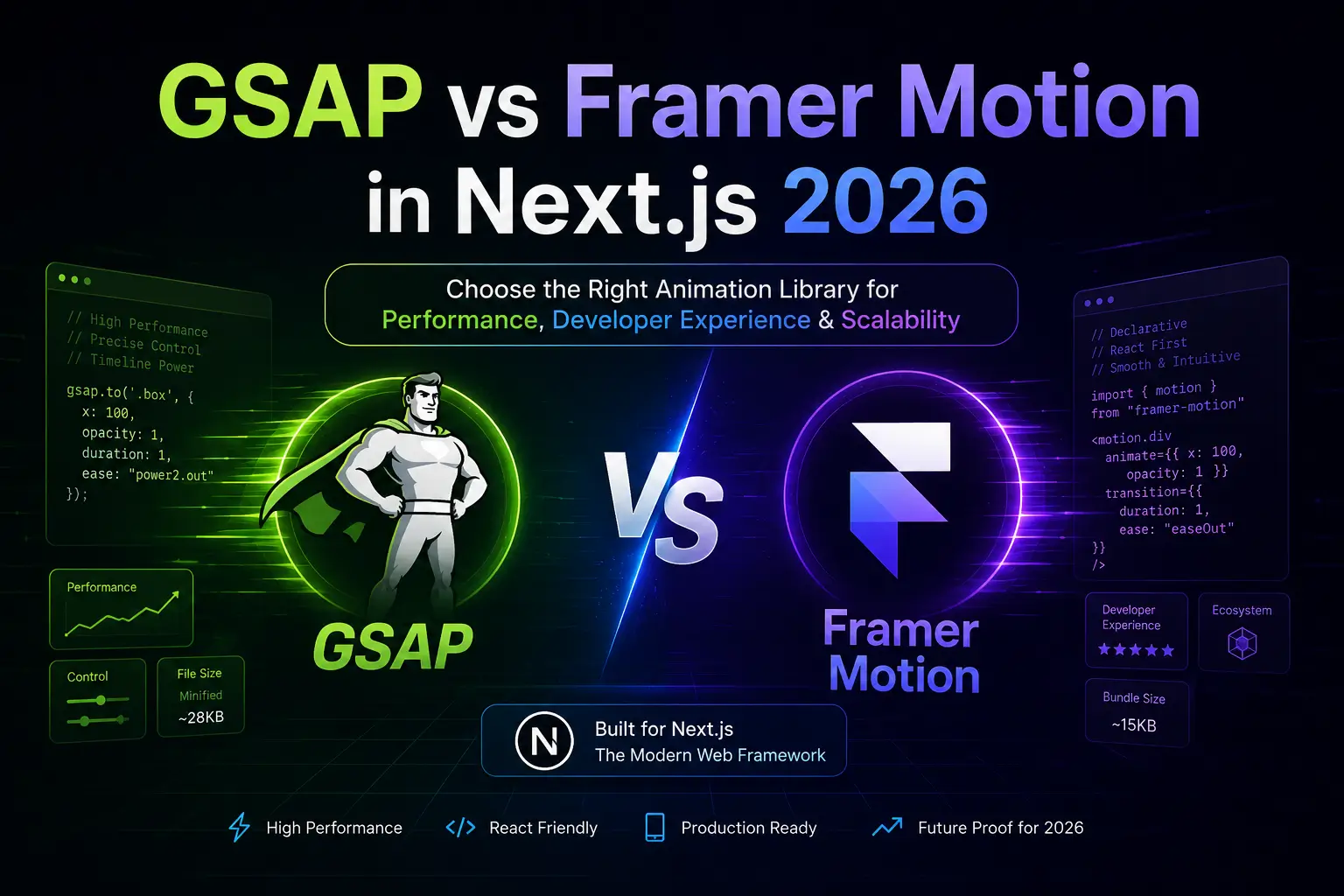
Every time this question surfaces in a Slack thread or a technical discovery call, the answers split along predictable tribal lines. Framer Motion advocates cite its React-native API and declarative syntax. GSAP advocates cite its timeline precision and battle-tested performance under real browser load. Both camps are partially right and both are missing the architectural question that actually determines the answer in a production Next.js environment.
The real question is not which library is better. It is which library solves the specific animation problem you are facing, inside a rendering model that neither library was originally designed for.
Next.js App Router changes the calculus significantly. You are not building a client-side SPA with a single hydration boundary and predictable mount lifecycle. You are working inside a hybrid rendering environment where React Server Components coexist with Client Components, where streaming HTML arrives in chunks, where partial hydration is the default, and where the browser's main thread budget is accounted for before your animation code has loaded.
Both GSAP and Framer Motion have real friction points in this environment and understanding those friction points is what separates an animation architecture that holds up under production load from one that looks impressive in local dev and degrades badly in the field.
If you have not yet read the deeper engineering breakdown on hydration-safe animation systems, start with the production architecture guide on GSAP & Framer Motion optimisation in Next.js 15. That article explains the rendering lifecycle mechanics, hydration isolation strategies, and bundle-splitting patterns this comparison builds on.
Why Animation Architecture Matters in Next.js
Animation is not a cosmetic layer you apply after the application works. In a Next.js App Router environment, animation decisions touch the rendering model at a structural level.
When you mark a component "use client", you are creating a hydration boundary. Everything below that boundary downloads as JavaScript, executes on the main thread, and contributes to your INP budget. If your animation library initialises inside that boundary pulling its runtime, registering its plugins, and parsing its configuration it is consuming main thread time before any user interaction has occurred.
That cost shows up in your Interaction to Next Paint field data as elevated latency on first interactions. This is one of the core reasons why teams performing Core Web Vitals optimisation increasingly treat animation architecture as a performance engineering concern rather than a pure design concern.
The streaming rendering model adds a second concern. Next.js streams HTML to the browser in chunks as server components resolve. Your animation library may begin initialising against a partially streamed DOM a DOM where not all elements it intends to target have been painted yet.
The resulting behaviour ranges from silently wrong (animations firing on incomplete targets) to visibly broken layout shifts from elements animating before their containers hydrate). This is exactly the kind of hydration failure explored in the full Next.js animation optimisation guide.
What GSAP Actually Is (Beyond the Marketing)
GSAP GreenSock Animation Platform is an imperative, engine-first JavaScript animation library. It has been in continuous production use since 2008, which means it has been tested against browser rendering quirks, hardware acceleration edge cases, and mobile GPU constraints that newer libraries have never encountered.
Its core is a timeline engine. You define animation sequences as ordered operations on DOM nodes, JavaScript objects, SVG attributes, or CSS variables and GSAP executes them with sub-millisecond precision against the browser's requestAnimationFrame loop.
The GSAP plugin ecosystem ScrollTrigger, ScrollSmoother, MorphSVG, SplitText, Draggable, Flip extends this engine into territory that no other animation library currently covers at comparable quality.
For teams building custom full-stack applications where animation is part of the product experience itself rather than a decorative layer, GSAP's orchestration model is often the correct architectural choice.
What Framer Motion Actually Is
Framer Motion is a declarative, React-first animation library. Its design philosophy is that animation state should live alongside component state expressed directly through props on motion-aware components instead of imperative timeline definitions inside effect hooks.
The library's AnimatePresence API handles exit animations elegantly. Its layout prop implements FLIP-based shared layout transitions with minimal configuration. Its LazyMotion architecture allows feature-bundle loading strategies that reduce unnecessary runtime weight in Next.js environments.
This makes Framer Motion especially effective for product interfaces, SaaS dashboards, and component-driven UI systems where interaction polish matters but scroll choreography is not the primary storytelling mechanism.
For teams building premium interfaces inside larger high-performance design systems, Framer Motion integrates naturally into component libraries and reusable UI primitives.
Core Differences: The Comparison That Actually Matters
| Dimension | GSAP | Framer Motion |
|---|---|---|
| Mental Model | Imperative timeline engine | Declarative React state |
| React Integration | Adapter (useGSAP) required | Native built for React |
| Bundle Size (core) | ~67kb min (without plugins) | ~18kb (domAnimation) |
| Scroll Systems | Full ScrollTrigger orchestration | Basic viewport triggers |
| Complex Timelines | First-class support | Limited |
| Exit Animations | Manual orchestration | Native AnimatePresence |
| SSR Compatibility | Requires hydration isolation | Easier but still requires care |
| INP Under Heavy Load | Better at scale | Can degrade under dense animations |
| Developer Learning Curve | Steeper | Faster onboarding |
| Best Use Case | Scroll storytelling, immersive experiences | Product UI, micro-interactions |
The architectural distinction matters more than the API syntax. Teams choosing purely on developer ergonomics often end up rebuilding missing orchestration features later.
Performance Comparison: What the Numbers Don't Tell You
Bundle size comparisons between GSAP and Framer Motion are real, but frequently misunderstood.
GSAP's core library is heavier initially, but when deferred correctly using next/dynamic and isolated inside non-blocking client chunks, it does not necessarily damage your LCP or INP metrics.
Framer Motion's domAnimation bundle is lightweight but only when teams correctly use LazyMotion and imports. Naive motion. imports can easily pull the full runtime synchronously into your primary bundle.
In practice, the performance outcome is less about the library itself and more about whether your architecture correctly handles:
- Deferred loading
- Hydration-safe initial states
- Main-thread scheduling
- GPU layer cleanup
- Scroll batching
- Context disposal
The complete implementation patterns for these optimisations are covered in detail inside the Next.js 15 animation optimisation architecture guide.
Scroll Animations and Complex Timelines
This is where GSAP wins categorically.
ScrollTrigger supports:
- Scrubbed animations
- Pinning
- Horizontal scroll systems
- Velocity-aware timelines
- Batched scroll reveals
- Scroll-linked parallax orchestration
- Timeline reversal and seek control
Framer Motion can approximate simple scroll reveals with whileInView and useScroll, but it does not provide a production-grade scroll orchestration engine equivalent to ScrollTrigger.
If your website depends heavily on cinematic storytelling, immersive landing pages, or editorial-style scroll experiences, GSAP is the correct tool.
This is particularly true for agencies and product teams building premium portfolio-driven web experiences where motion quality directly influences perceived brand sophistication.
Page Transitions and Micro-Interactions
This is Framer Motion's territory.
Page transitions in App Router environments become dramatically simpler with AnimatePresence. Shared layout transitions become trivial with layoutId. Hover states, accordions, modal entrances, tab indicators, and interaction polish all fit naturally into Framer Motion's declarative model.
For authenticated SaaS interfaces and dashboard-style applications, Framer Motion is often the faster and more maintainable solution.
The engineering overhead difference becomes significant at scale. A Framer Motion interaction often requires only a prop change. The equivalent GSAP implementation usually requires refs, effect orchestration, cleanup management, and timeline control.
Developer Experience: What Ships Faster and What Breaks Less
Framer Motion generally ships faster for component-level interactions because it aligns naturally with React's mental model.
GSAP generally scales further for complex animation systems because its timeline engine was designed specifically for orchestration rather than component transitions.
The trade-off is architectural complexity.
GSAP requires stronger discipline around:
- Hydration isolation
- Lifecycle cleanup
- Context scoping
- Dynamic imports
- SSR-safe initialisation
Framer Motion requires stronger discipline around:
- Bundle splitting
LazyMotion- Preventing unnecessary renders
- Avoiding animation density that overloads React reconciliation
Neither library is inherently "better engineered." They are engineered for different animation domains.
SEO and Core Web Vitals
Animation architecture now has direct SEO consequences.
Google's field metrics evaluate:
- Largest Contentful Paint (LCP)
- Interaction to Next Paint (INP)
- Cumulative Layout Shift (CLS)
Poorly integrated animation systems damage all three.
This is why production animation work increasingly overlaps with technical SEO engineering and Core Web Vitals consulting.
The practical rules are consistent regardless of library:
- Never block the critical rendering path
- Never animate layout-affecting properties during hydration
- Always reserve layout space with skeletons
- Always defer heavy animation runtimes
- Always dispose animation contexts correctly
- Always profile under realistic CPU throttling
Animation quality without rendering discipline becomes technical debt disguised as design.
When to Use GSAP
Use GSAP when:
- You need ScrollTrigger
- You need scrubbed timelines
- You need cinematic page choreography
- You need SVG morphing
- You need pinned scroll sections
- You need high-density concurrent animations
- You need precise playback control
GSAP is the correct choice for immersive storytelling experiences and animation-led interfaces.
When to Use Framer Motion
Use Framer Motion when:
- You are building application UI
- You need fast component-level interactions
- You rely heavily on exit animations
- You need shared layout transitions
- Your animation complexity stays component-scoped
- Your engineering team prefers declarative React patterns
Framer Motion is exceptionally effective for scalable product UI systems.
When to Use Both Together
Many senior Next.js teams eventually converge on a dual-library architecture:
- GSAP owns scroll systems and orchestration
- Framer Motion owns component interactions
This separation works because the two libraries solve different categories of animation problems.
Used correctly, they coexist cleanly inside the same Next.js application without architectural conflict.
The key is discipline:
- Clear ownership boundaries
- Deferred bundle loading
- Shared hydration-safe architecture
- Strict cleanup conventions
The implementation strategy for this setup is covered in depth inside the companion guide on GSAP & Framer Motion optimisation in Next.js 15.
Final Verdict
If you are building scroll-driven storytelling experiences, GSAP is the stronger architectural tool.
If you are building application UI and interaction-heavy component systems, Framer Motion is the stronger architectural tool.
If your product spans both domains premium marketing experiences plus sophisticated application surfaces the best solution is often both libraries with clearly separated responsibilities.
The important engineering lesson is that animation performance is no longer isolated from SEO, Core Web Vitals, rendering architecture, or business outcomes. In the modern full-stack landscape, an unoptimized motion framework configuration acts as a silent bottleneck on your critical rendering path. It directly compromises your Core Web Vitals, inflates your Interaction to Next Paint (INP) latency on low-end mobile devices, and introduces severe main-thread friction that compromises user retention.
To bridge the gap between visual aesthetics and runtime precision, animation must be accounted for within your initial performance budget. This requires strict monitoring of layout thrashing, main-thread blocking times, asynchronous chunk processing, layout shifting prevention, and hydration isolation boundaries. Premium web engineering means treating motion not as a superficial cosmetic layer, but as a core architectural asset that respects browser resource constraints, DOM node scalability, and runtime memory disposal.
Ultimately, selecting between GSAP and Framer Motion requires evaluating how each library handles server-side boundaries, component lifecycle unmounting, client-side route segment navigation caches, and main-thread execution limits. When built with runtime discipline, your motion framework becomes a conversion driver rather than a technical optimization challenge.
The animation library is not the product.
The performance of the product is the product.
Continue Reading
GSAP & Framer Motion in Next.js 15
A production-grade engineering guide for implementing GSAP and Framer Motion animations in Next.js 15 App Router without sacrificing Core Web Vitals or INP budgets.