
Local SEO for Small Business: UK Guide 2026
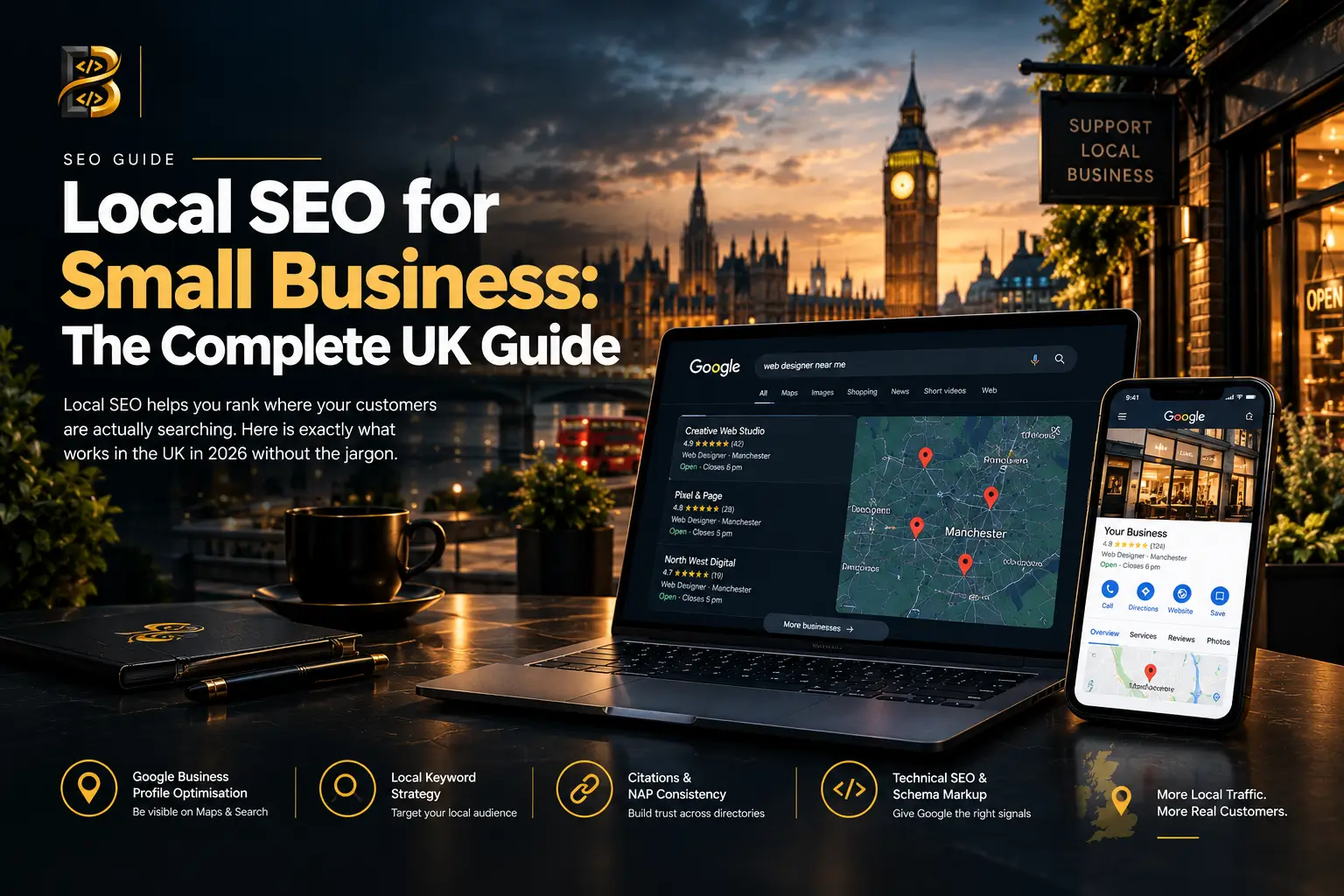
Local SEO for Small Business: What Actually Works in the UK
If your business serves customers in a specific town, city, or region and those customers search Google before they buy local SEO is the highest-return marketing activity available to you. Not social media. Not paid ads. Not email. Local SEO.
The reason is simple: someone searching "web designer near me" or "accountant in Leeds" is not browsing. They are ready to hire. Local SEO puts your business in front of that person at exactly the moment they have decided to act. No other channel does that as consistently or as cost-effectively over time.
This guide covers exactly what local SEO for small businesses involves in 2026, what you need to do to rank in UK local search results, and where most small businesses are losing ground without realising it.
What Local SEO Actually Means
Local SEO is the process of optimising your online presence so your business appears in Google Search and Google Maps when people nearby search for what you offer. It is distinct from general SEO in one important way: the ranking signals Google uses for local results include proximity, relevance, and prominence not just domain authority and backlinks.
This means a small business with a well-optimised local presence can outrank large national competitors for searches in their area. A Manchester-based web agency can outrank a London agency for searches made by businesses in Manchester. A Bristol bakery can outrank a national chain for "bakery near me" searches made in Bristol.
That is the opportunity. Most small businesses in the UK are not capturing it because their Google Business Profile is incomplete, their website has no local content, and their citations are inconsistent across directories.
Google Business Profile: The Foundation of Local SEO
Your Google Business Profile (GBP) formerly Google My Business is the single most important element of local SEO for small businesses. It is what populates the map pack: the three business listings that appear at the top of Google search results for local queries, above the organic results.
A properly optimised GBP does the following:
Complete every field. Business name, address, phone number, website, hours, categories, and service areas all need to be filled in accurately. Incomplete profiles rank lower. Google rewards completeness because it gives searchers more confidence in the result.
Choose the right primary category. Your primary category is the most significant ranking signal in your GBP. If you are a web design agency, your primary category should be "Web designer" or "Website designer," not "Digital marketing agency" or "Software company." Be specific and accurate.
Add services and products. Google allows you to list specific services under your business profile. Use this. A web agency should list services like website design, SEO, ecommerce development, and WordPress development individually each one is a ranking opportunity for related searches.
Post regularly. Google Business Profile posts updates, offers, events are a direct signal of business activity. Businesses that post at least once a week consistently outperform inactive profiles in local rankings.
Collect and respond to reviews. Review volume and recency are significant local ranking factors. A business with 50 reviews averaging 4.8 stars outranks a competitor with 10 reviews at 5.0. Respond to every review positive and negative. It signals engagement to Google and professionalism to potential clients.
Local SEO on Your Website
Your Google Business Profile handles your Map Pack visibility. Your website handles your organic local search visibility the results that appear below the map pack. Both matter. Businesses that rank in both positions capture significantly more traffic than those appearing in only one.
Local Landing Pages
If your business serves multiple areas, create a dedicated page for each one. A web development agency serving Manchester, Leeds, and Birmingham should have separate pages targeting each city not a single "Areas We Serve" page with three bullet points.
Each local landing page needs:
- The location keyword used naturally in the page title, H1, and first paragraph
- Genuine content about the service in that location not the same text duplicated with the city name swapped
- A local phone number or contact method if possible
- Embedded Google Map showing your business or the service area
- Local schema markup (more on this below)
NAP Consistency
NAP stands for Name, Address, Phone number. Google cross-references your NAP data across your website, your Google Business Profile, and hundreds of online directories. Inconsistencies different phone numbers, abbreviated address formats, old trading names create conflicting signals that suppress your local rankings.
Audit your NAP data across your website, GBP, Yell, Yelp UK, Thomson Local, FreeIndex, and any industry-specific directories relevant to your sector. Every listing needs to match exactly.
Location-Specific Content
Blog content targeting local search terms is one of the most underused local SEO tactics for small businesses in the UK. A solicitor in Sheffield writing about "business contract disputes in Sheffield" captures local search traffic that a generic "business law" article never will.
Think about the questions your local customers ask, the local context that is specific to your market, and the search terms that combine your service with your location. That content compounds over time each piece builds your local authority incrementally.
Local Citations and Directory Listings
A citation is any online mention of your business name, address, and phone number. Citations on high-authority UK directories tell Google that your business is legitimate, established, and located where you say it is.
The UK directories worth prioritising:
- Yell.com
- Thomson Local
- Bing Places for Business
- Apple Maps Connect
- FreeIndex
- Checkatrade (for tradespeople)
- Trustpilot
- Industry-specific directories relevant to your sector
Consistency matters more than volume. Twenty consistent, accurate citations outperform fifty inconsistent ones.
Schema Markup for Local Businesses
Schema markup is structured data added to your website's code that tells Google explicitly what your business is, where it is, and what it does. For local SEO, the most important schema types are LocalBusiness, Service, and Review.
A properly implemented LocalBusiness schema on your homepage communicates your business name, address, phone number, opening hours, geographic coordinates, and service area directly to Google in a format it can process without interpreting your page content.
Most small business websites in the UK have no schema markup at all. Implementing it correctly is a meaningful competitive advantage that most of your local competitors have not taken.
This is where technical SEO and local SEO intersect and where working with an agency that understands both disciplines produces better results than working with one that specialises in only one. Our SEO services cover schema implementation as a standard part of every local SEO engagement, not a billable extra.
Local SEO for Small Businesses: Common Mistakes
These are the errors that consistently suppress local rankings for UK small businesses.
Inconsistent NAP data. The most common and most damaging local SEO problem. An old phone number on Yell, a different business name format on Thomson Local, and a different address on the website create conflicting signals Google cannot resolve cleanly.
An unclaimed or incomplete Google Business Profile. A surprising number of UK small businesses either have not claimed their GBP or have left it with default information. An unclaimed profile cannot be optimised and is often populated with incorrect information from third-party data sources.
No local content on the website. A website with no location-specific pages, no local blog content, and no geographic signals gives Google no reason to associate it with searches in a specific area.
Ignoring reviews. Not asking for reviews, not responding to existing ones, and not addressing negative reviews all signal low engagement to Google and low trustworthiness to potential clients.
Keyword stuffing location terms. Writing "web design Manchester Manchester web design Manchester agency" in a page footer does not help local rankings. It hurts them. Location keywords need to appear naturally in content that genuinely serves the reader.
How Long Does Local SEO Take to Work?
Local SEO is not a switch. It is a compounding investment. Most small businesses see meaningful movement in local rankings within three to six months of implementing the fundamentals correctly GBP optimisation, NAP consistency, local landing pages, and citation building.
The Map Pack tends to respond faster than organic local results because GBP signals update more frequently than website authority signals. A well-optimised GBP with consistent citations and recent reviews can show ranking improvement within four to eight weeks.
Ongoing content local blog posts, updated service pages, regular GBP posts continues to compound that authority over months and years. The businesses that dominate local search in their area are almost always the ones that have been consistent for the longest time, not the ones that spent the most in a single month.
Local SEO Services for Small Business: What to Expect from an Agency
If you are evaluating local SEO services for your small business, here is what a professional engagement should include as standard.
A full audit of your current local presence GBP status, NAP consistency, existing citations, website local signals, and competitor analysis. Local keyword research identifying the specific search terms your target customers are using in your area. GBP optimisation covering every field, category selection, and service listings. Citation building and cleanup across UK directories. On-page optimisation of your website's local signals location pages, schema markup, internal linking. Monthly reporting showing ranking movement, GBP performance, and citation status.
What it should not include: guaranteed ranking positions, vague "optimisation" activities with no clear deliverables, or a one-time setup with no ongoing management. Local SEO requires consistent attention. A one-time audit is a starting point, not a service.
At Build With Umar, our local SEO services for small businesses in the UK are built on the same technical foundations we use for every web project schema implementation at code level, performance-optimised local landing pages on Next.js, and citation management that produces consistent NAP signals across every relevant directory. Get in touch to discuss what your local search presence currently looks like and what it would take to improve it.
If you are also considering a new website alongside your local SEO work, our web development services deliver local landing pages built for performance from day one not retrofitted onto a slow theme after launch.
Frequently Asked Questions
What is local SEO for small businesses?
Local SEO is the process of optimising your online presence so your business appears in Google Search and Google Maps when nearby customers search for what you offer. It includes optimising your Google Business Profile, building consistent directory citations, creating location-specific website content, and implementing structured data. For small businesses serving a specific area, it is typically the highest-return digital marketing activity available.
How much does local SEO cost for a small business in the UK?
Local SEO services for small businesses in the UK typically cost £300–£800 per month for a professional ongoing engagement. One-time audits and setup packages range from £500 to £2,000 depending on scope. Agencies charging below £200 per month are usually providing automated reports with minimal actual work. The right budget depends on your market's competitiveness and how much of your revenue comes through local search.
How long does local SEO take to show results?
Most businesses see meaningful ranking movement within three to six months of implementing local SEO correctly. Google Business Profile improvements tend to show faster sometimes within four to eight weeks. Organic local search results take longer because they depend on accumulated website authority. Local SEO compounds over time consistent effort over twelve months produces significantly better results than an intensive three-month campaign followed by nothing.
Is Google Business Profile free?
Yes Google Business Profile is completely free to create and maintain. It is also the single most important local SEO asset for most small businesses. Claiming, verifying, and fully optimising your GBP costs nothing except time and is the first step any small business should take before spending anything on local SEO services.
Why is local SEO important for small businesses?
Local SEO puts your business in front of customers who are actively searching for what you offer in your area the highest-intent audience available to any business. Someone searching "accountant in Leeds" or "web designer near me" has already decided they need the service. Local SEO determines whether they find you or your competitor. For businesses that serve a defined geographic area, it is more cost-effective than paid advertising over any period longer than six months.
What is the difference between local SEO and regular SEO?
Regular SEO targets broad keywords regardless of location "web design agency" or "accountant services." Local SEO targets location-specific searches "web design agency Manchester" or "accountant Sheffield" and uses Google Maps rankings alongside organic results. Local SEO uses additional signals that regular SEO does not: Google Business Profile optimisation, local citations, NAP consistency, and geographic schema markup. Both matter for most small businesses, but local SEO typically produces faster, more directly commercial results.