
Headless Ecommerce Development Agency
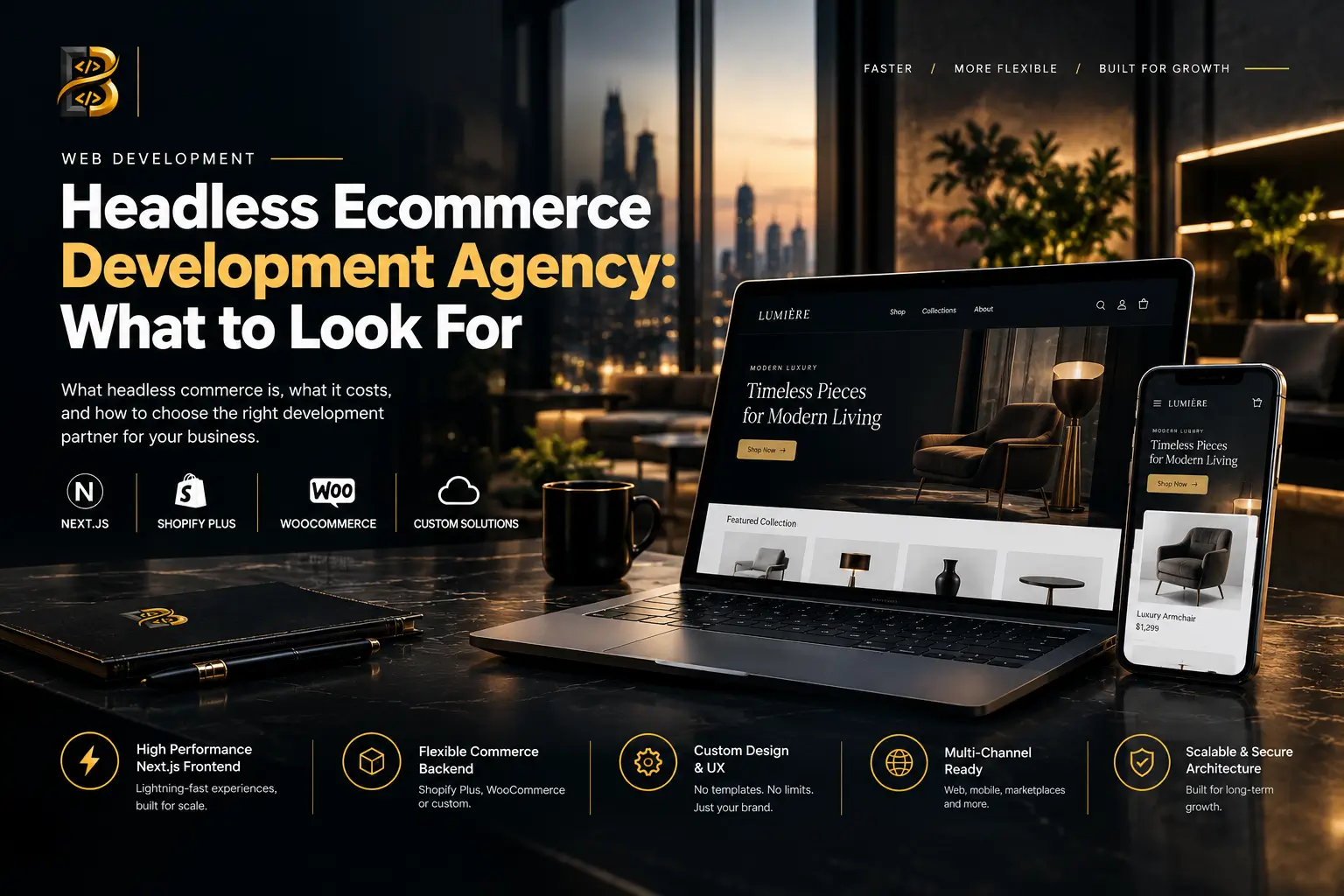
Headless Ecommerce Development Agency: What Sets the Best Apart
Most ecommerce businesses hit the same ceiling at some point. Traffic grows, product catalogue expands, paid campaigns start performing and then the platform starts fighting back. Pages slow down under load. The checkout flow cannot be customised without breaking something else. A new market requires a different currency and language setup that the theme does not support cleanly. The design team has ideas the template physically cannot execute.
This is not a content problem or a marketing problem. It is an architecture problem. And the solution is headless ecommerce.
Choosing the right headless ecommerce development agency to build that architecture is one of the most consequential technical decisions a growing ecommerce business makes. This guide explains what headless commerce actually involves, what separates agencies that deliver results from those that overpromise, and what you should expect from a professional engagement.
What Headless Ecommerce Development Actually Means
In a traditional ecommerce setup Shopify, WooCommerce, Magento the platform handles everything: product data, inventory, checkout logic, and the frontend your customers see. They are coupled together. What the platform can render is what your customers get.
Headless ecommerce decouples those responsibilities. The commerce backend product catalogue, inventory management, cart, checkout, payment processing handles what it does well. A separate frontend framework in most modern builds, Next.js handles what your customers see, completely independently.
The two communicate via APIs. The commerce backend sends data. The Next.js frontend renders it however the business requires with no template constraints, no theme limitations, and no platform-imposed design ceiling.
What this unlocks in practice:
Your frontend is no longer constrained by what Shopify's Liquid templating or WooCommerce's theme system can render. Every pixel, every interaction, every animation is engineered specifically for your brand. Sub-second page loads become achievable because product pages are pre-rendered as static HTML at build time and served from edge CDN nodes not generated on request from a database.
Your commerce backend becomes replaceable. If you outgrow Shopify, you swap the backend without rebuilding the frontend. If you add a new sales channel, you connect it to the same API layer without touching the storefront.
Why Businesses Move to Headless Ecommerce
The decision to invest in headless architecture is almost always triggered by one of four problems.
Performance ceiling. A Shopify or WooCommerce storefront running third-party apps, tracking scripts, and a feature-heavy theme is structurally limited in how fast it can load. Every app adds JavaScript. Every plugin adds database queries. The result is mobile PageSpeed scores in the 30s and 40s scores that directly suppress both conversion rates and search rankings. A headless Next.js frontend removes that overhead entirely. Product pages built on static generation with edge delivery consistently score 95+ on mobile.
Design constraints. Premium brands cannot express their visual identity through a theme. Cinematic scroll animations, immersive product experiences, editorial-style layouts, and custom interaction design are not achievable inside a Shopify or WooCommerce template. A custom Next.js frontend has no design ceiling anything a browser can render, the storefront can deliver.
Scaling for multiple markets. A single storefront serving multiple countries, languages, and currencies is a configuration nightmare on coupled platforms. Headless architecture handles internationalisation at the API and rendering layer different regions get different content, pricing, and language without maintaining separate platform instances.
Platform lock-in. Businesses running on Shopify pay platform fees, transaction fees, and app subscription fees indefinitely. A headless architecture separates the frontend from the commerce backend giving businesses the option to use Shopify purely as a product and inventory management tool while owning their storefront completely.
What a Headless Ecommerce Development Agency Actually Builds
A professional headless ecommerce development engagement is not a theme swap or a plugin configuration. It is a full-stack engineering project covering several interconnected systems.
The Commerce Backend
The backend is where product data, inventory, pricing, promotions, cart logic, and checkout processing live. In most US headless builds, this is one of three options.
Shopify Plus is the most common choice for businesses already on Shopify. Shopify handles the commerce operations; Next.js takes over the storefront. The Storefront API connects them. This is the fastest path to headless for existing Shopify merchants the product data, orders, and fulfilment workflows stay exactly where they are.
WooCommerce headless suits businesses with complex product configurations, custom checkout logic, or specific hosting requirements. The WooCommerce REST API or GraphQL (via WPGraphQL) feeds the Next.js frontend. Combined with our web development services, this setup gives businesses full ownership of both the commerce backend and the storefront.
Medusa.js is an open-source commerce engine designed specifically for headless builds. For businesses starting from scratch or migrating away from Shopify's fee structure, Medusa provides a modern API-first backend with no platform fees and complete customisation capability.
The Next.js Frontend
The storefront is a Next.js application built from scratch, not adapted from a starter template. Product pages use Static Site Generation with Incremental Static Regeneration so inventory and pricing stay current without sacrificing the performance of pre-rendered pages. Category pages, search results, and promotional landing pages are all engineered as separate, optimised templates.
The design is custom built to the brand's exact specifications, not constrained by what a pre-made component library ships with. GSAP or Framer Motion handles animation where the experience demands it, with the performance discipline to keep Core Web Vitals scores green throughout.
CMS Integration
Content editorial pages, campaign landing pages, blog content, promotional banners is managed through a headless CMS. Sanity and Contentful are the two most common choices for US ecommerce brands. Both give marketing and content teams full editorial control through a clean interface, with changes published to the storefront without code deployments.
Technical SEO Architecture
Every product page, category page, and CMS-driven page needs properly structured metadata, JSON-LD schema, canonical tags, and hreflang configuration for international builds. In a headless architecture, this is handled programmatically in the Next.js application not through a plugin that generates generic schema across all page types.
Our SEO services are integrated into every headless build we deliver, because a fast storefront that Google cannot properly index is only solving half the problem.
What Separates a Strong Headless Ecommerce Agency
The headless ecommerce development market in the US includes agencies with genuine engineering capability and a much larger number of agencies that have rebranded their Shopify configuration work as "headless." The distinction matters significantly when the project costs $20,000 to $100,000+.
They build on Next.js, not a storefront starter kit. Starter templates like Shopify's Hydrogen or generic Next.js commerce starters are starting points, not finished storefronts. A strong agency uses these as reference points while building a codebase engineered specifically for the client's requirements not a configured template with custom CSS on top.
They can explain their rendering strategy. Ask any agency you are evaluating how they handle product page rendering. A strong answer references Static Site Generation, Incremental Static Regeneration for inventory freshness, and edge delivery. An agency that cannot explain this clearly is not making informed architecture decisions.
They have a defined approach to Core Web Vitals. Every headless build should target 95+ PageSpeed scores on mobile. Ask for live client site scores. An agency that cannot share real performance data from production storefronts is not delivering the performance that headless architecture is supposed to provide.
Technical SEO is included, not optional. Headless storefronts have specific SEO requirements server-side rendering for crawlability, programmatic metadata, structured data, canonical tag management across dynamic routes. These cannot be retrofitted. Ask explicitly whether technical SEO architecture is part of the build scope.
They scope clearly before quoting. A headless ecommerce project involves commerce backend configuration, API integration, frontend engineering, CMS setup, performance optimisation, and launch. Each of these phases has defined deliverables. An agency that quotes without a discovery process is not accounting for the complexity involved.
Headless Ecommerce Development Services: What a Professional Engagement Includes
A properly scoped headless ecommerce development engagement covers the following as standard.
Discovery and architecture planning defining the commerce backend, frontend framework, CMS, API connections, and performance targets before any development begins.
Custom UI/UX design built to brand specifications, not adapted from a theme or component library.
Next.js storefront development product pages, category pages, search, cart, and checkout all engineered as dedicated, optimised templates.
Commerce backend configuration Shopify Plus Storefront API connection, WooCommerce REST or GraphQL setup, or Medusa.js backend deployment depending on the chosen stack.
Headless CMS integration Sanity or Contentful connected to the storefront with structured content models for editorial and promotional content.
Technical SEO setup metadata architecture, structured data, sitemap generation, and Core Web Vitals optimisation built into the application.
Performance optimisation image delivery via next/image, font loading via next/font, JavaScript bundle analysis, and edge CDN configuration.
QA, staging, and launch cross-device and cross-browser testing, performance verification against agreed benchmarks, and a structured launch process.
Post-launch support defined support period covering bug fixes, content updates, and performance monitoring.
How Much Does Headless Ecommerce Development Cost in the US?
Headless ecommerce development is a significant investment. The range is wide because project complexity varies enormously.
A focused headless storefront migration existing Shopify merchant moving to a Next.js frontend with Shopify Plus backend, custom design, and CMS integration typically costs $20,000 to $45,000 in the US.
A full headless build from scratch new commerce backend, custom Next.js storefront, CMS, internationalisation, and complex product configuration runs $45,000 to $100,000+.
Ongoing retainer support performance monitoring, content updates, feature additions, and technical SEO management typically costs $2,000 to $5,000 per month depending on scope.
Agencies quoting significantly below these ranges for complex headless builds are delivering something other than genuine headless architecture usually a Shopify theme with a Next.js wrapper, or a starter template with minimal customisation.
Build With Umar: Headless Ecommerce Development for US Businesses
At Build With Umar, our headless ecommerce development services are built on a defined stack Next.js frontend, Shopify Plus or WooCommerce backend, Sanity or Contentful CMS engineered from scratch for each client's specific requirements.
We work with US ecommerce businesses that have outgrown their current platform and need a storefront that performs at the level their brand demands. If your current site is hitting a performance, design, or scalability ceiling, book a free discovery call. We will assess your current stack and give you a straight answer on what a headless build would involve and what it would cost for your specific operation.
Frequently Asked Questions
What is headless ecommerce development?
Headless ecommerce separates the commerce backend products, inventory, checkout from the customer-facing frontend. A Next.js application handles the storefront independently, pulling data from the backend via APIs. This removes platform design constraints, enables sub-second page loads through static generation and edge delivery, and gives businesses complete control over their customer experience without being limited by what a platform theme can render.
How much does headless ecommerce development cost in the US?
A focused headless storefront migration costs $20,000–$45,000. A full headless build from scratch runs $45,000–$100,000+. Ongoing support retainers cost $2,000–$5,000 per month. Quotes significantly below these ranges for complex builds typically indicate a starter template or theme-based approach rather than genuine custom headless development.
How long does a headless ecommerce build take?
A standard headless storefront migration takes ten to sixteen weeks from kickoff to launch. Full builds with custom commerce backend, CMS, and internationalisation run sixteen to twenty-four weeks. Timeline depends heavily on scope clarity, content readiness, and third-party integration complexity. Rushing a headless build below ten weeks almost always means skipping discovery, design iteration, or QA.
Is headless ecommerce worth it for small businesses?
Headless architecture makes the most sense for businesses processing significant transaction volume, running high paid traffic spend, competing on brand experience, or scaling across multiple markets. For a small business with low traffic and a simple product catalogue, the investment is difficult to justify. The performance and design advantages of headless architecture produce the clearest ROI for businesses where site speed and conversion rate directly affect meaningful revenue.
What commerce backends work with headless ecommerce?
The most common US headless commerce backends are Shopify Plus (via Storefront API), WooCommerce (via REST API or WPGraphQL), and Medusa.js for businesses building from scratch or avoiding platform fees. The right choice depends on your existing setup, product complexity, and long-term platform ownership goals. Shopify Plus is the fastest migration path for existing Shopify merchants. Medusa.js is the right choice for businesses that want complete backend ownership with no recurring platform fees.
What is the difference between headless and traditional ecommerce?
Traditional ecommerce platforms Shopify, WooCommerce, Magento couple the backend and frontend together. The platform controls both the data and how it is rendered. Headless ecommerce separates them. The backend manages commerce operations; a custom frontend handles the customer experience. The result is faster load times, complete design freedom, easier multi-market scaling, and reduced dependency on platform limitations and fee structures.